

Child sexual abuse more common than most parents think
Every year, Australian governments, health bodies, and community organisations invest hundreds of millions of dollars in public awareness campaigns. Road safety. Mental health. Cancer screening. Domestic violence. These campaigns exist because the evidence showed a problem, and the public and political will existed to respond to it.
That process – from evidence to awareness to action – works. It saves lives. It changes behaviour. It reduces suffering.
So it is worth asking, with genuine curiosity rather than blame, why child sexual abuse has not followed the same path.
What the research actually shows
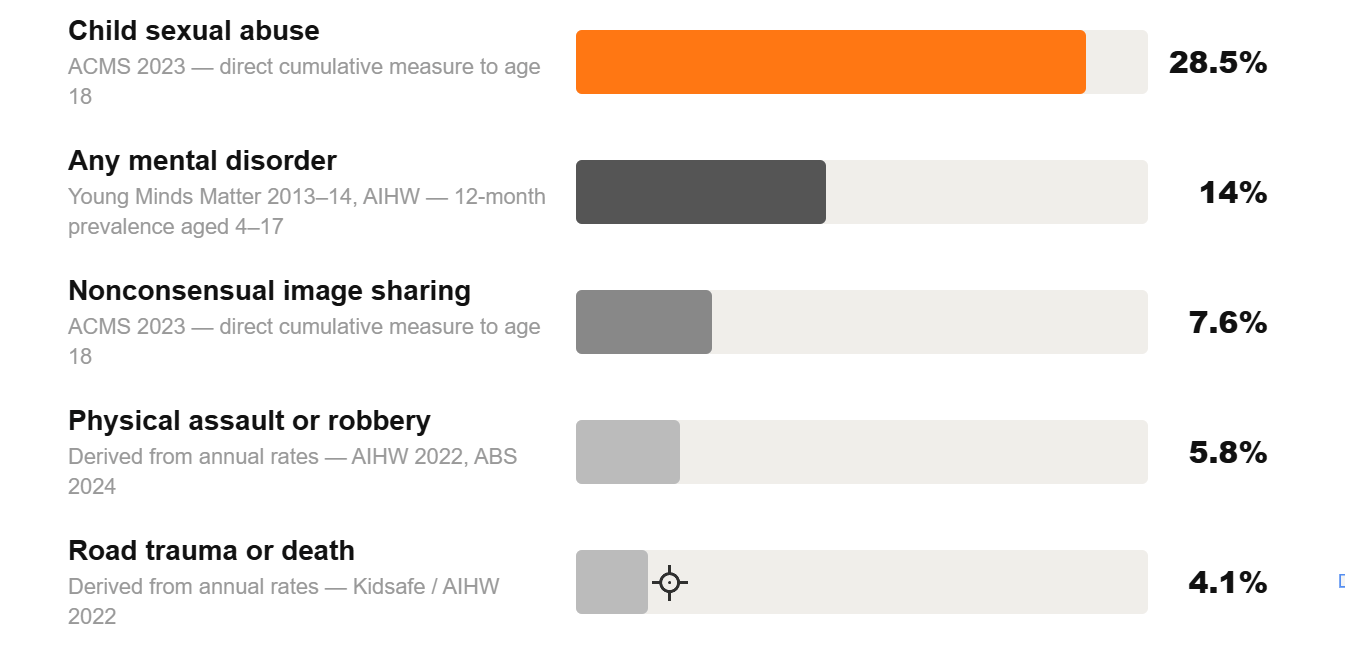
The Australian Child Maltreatment Study (ACMS), published in 2023, is the most comprehensive national study of child maltreatment ever conducted in Australia. Its findings on the prevalence of child sexual abuse are striking. According to the ACMS, 28.5 per cent of Australians experienced child sexual abuse before the age of 18.
That is more than one in four Australians. Roughly 6.8 million people alive today.
For context, the conditions that attract the most sustained public health attention and government investment in Australia have considerably lower prevalence in childhood. Childhood mental disorders affect around 14 per cent of children aged 4 to 17, according to AIHW data. The cumulative probability of a child being physically assaulted or robbed before the age of 18, derived from annual ABS crime data, sits at around 5 per cent. Road trauma, the risk parents most consistently act to prevent, carries a cumulative probability of around 4 per cent across childhood.
None of this is to suggest those other harms do not matter. They do. The point is simply that by any reasonable measure of scale, child sexual abuse belongs in the same conversation – and in most public health settings, it is not.
Why the gap exists
There is no single explanation for why child sexual abuse has not attracted the same level of sustained public attention as other childhood harms of comparable or lesser scale. Several factors are likely at work, none of them simple.
Visibility is part of it. Road trauma produces statistics that are easy to count and impossible to ignore. Deaths are recorded. Hospitalisations are recorded. The numbers accumulate in public databases and appear in annual reports. Child sexual abuse, by contrast, is profoundly under-reported. The ACMS data itself is drawn not from police or hospital records but from self-report surveys of adults describing their childhood experiences – because the recorded crime figures capture only a fraction of what actually occurs. The harm is real and widespread, but it is largely invisible in the systems we use to measure suffering.
Disclosure is another factor. The ACMS found that a significant proportion of survivors never disclosed their abuse at the time it occurred, and many have not disclosed it since. Abuse that is not disclosed is not reported. Abuse that is not reported does not appear in crime statistics. Statistics that do not exist do not generate campaigns.
There is also the discomfort of the subject itself. Road safety campaigns can be shown on television during the family viewing hour. Mental health campaigns run during school terms. Child sexual abuse is a topic that many institutions and many individuals have historically preferred not to raise directly – despite the Royal Commission into Institutional Responses to Child Sexual Abuse documenting in detail the consequences of that avoidance.
None of these factors amounts to a failure of intent. Most people in public health, government, and education genuinely want to protect children. The gap between what the evidence shows and what receives sustained attention is more a product of structural and social conditions than conscious choice.
But recognising that does not make the gap any smaller.
The case for open conversation
There is an understandable, well-meaning instinct to shield children from difficult subjects. Sex, bodies, and the ways adults can cause harm are not comfortable topics to raise at the dinner table or in the school pickup line. Most parents would rather their children stay innocent of such things for as long as possible.
And even when the intention is there, the words often aren’t. There is a specific kind of awkwardness that descends when these subjects come up – a not-quite-knowing-how-to-start, a worry about saying the wrong thing, a vague dread of making it strange between you and your child. It feels, in the moment, like a small and almost silly obstacle. Which is part of what makes it so persistent. It is hard to overcome something that seems too minor to justify the effort, even when the stakes behind it are anything but minor.
But that instinct, however loving, can work against the children it is trying to protect. A child who has grown up in an environment where bodies, boundaries, and relationships are spoken about openly – where questions are welcomed rather than deflected, where the correct names for things are used without embarrassment – is a child who is more likely to recognise when something is wrong, and more likely to believe they will be heard if they say so.
None of this is easy. Anyone who has raised a teenager knows that the channel of open communication is not always available or welcome. Adolescents, in particular, have a remarkable capacity for making parents feel that any attempt at meaningful conversation is approximately the most excruciating thing imaginable. That difficulty is real and it is worth acknowledging.
It is also not a reason to stop trying. The conversations do not need to be perfect to matter. They do not need to cover everything at once. What they need to do is establish, over time, that the subject is not unspeakable – that a young person who needs to say something difficult will find, in the people around them, a willingness to listen without judgment.
The taboo around child sexual abuse is not neutral. It does not simply reflect social discomfort – it actively shapes the environment in which abuse continues and in which survivors remain silent. A culture more willing to speak openly about sex, bodies, and safety is not a culture that prevents all abuse. But it is a culture in which abuse is less able to hide.
f you’re not sure where to start, several Australian organisations offer practical, age-appropriate guidance for parents. The Raising Children Network, the eSafety Commissioner, the National Office for Child Safety, and Body Talk all provide free resources designed to make these conversations less daunting.
What changes when we talk about it
The Royal Commission, which ran from 2013 to 2017, is perhaps the clearest example in Australian history of what happens when child sexual abuse becomes visible and speakable. More than 8,000 people shared their experiences. Institutions that had operated in silence for decades were scrutinised. Laws changed. Redress schemes were established. Statutes of limitation were reformed in most jurisdictions.
None of that happened because the abuse became more common. It happened because the conversation became possible.
The same dynamic operates at the individual level. Research consistently shows that children who grow up in environments where sexual abuse is openly discussed – where they understand what it is, know that it is not their fault, and believe they will be heard if they disclose – are more likely to report abuse earlier, and more likely to access support. Disclosure does not happen in a vacuum. It happens when someone feels safe enough to speak, and that safety is built long before it is needed.
The role of survivors
It is worth being direct about something the statistics cannot fully convey. Behind the 28.5 per cent figure are millions of individual lives. Many of those people spent years, sometimes decades, carrying the experience without being able to name it, discuss it, or seek help for it. Some are still doing so.
The barriers to disclosure are well documented. Fear of not being believed. Shame that belongs not to the survivor, but which survivors are too often left to carry alone. Concern about the consequences for family members or institutions. The plain difficulty of finding words for something that happened in childhood and was never spoken of.
For many survivors, the decision to finally speak is less a decision than a necessity. It comes not as a gradual resolution but as a reckoning – a divorce, a crisis, a moment of looking at their own child and understanding with sudden clarity what was done to them, or simply the recognition that the weight of it can no longer be managed alone. Sometimes it is something smaller still: a conversation overheard, an article read, a story told by someone else that makes the unspeakable suddenly feel possible to say.
What those moments have in common is that they are made harder or easier by the environment around them. A survivor who reaches that point in a culture that still treats the subject as shameful or unspeakable faces a higher barrier than one who reaches it in a culture that has learned to listen without judgment. That is not a small difference. For some people, it is the difference between making the call and not making it.
A note on civil compensation
For survivors who are considering what options remain available to them, it is worth knowing that the legal landscape has changed significantly in the years since the Royal Commission. Statutes of limitation for civil claims have been reformed in all Australian states and territories, meaning that survivors who were abused decades ago are no longer automatically barred from seeking compensation through the courts. Institutions that enabled abuse through negligence or deliberate concealment can be held liable, regardless of how long ago the abuse occurred.
The law cannot undo what happened. But for many survivors, a civil compensation process provides something the criminal law rarely offers: an acknowledgment, an accounting, and a measure of control over a story that was taken from them.
If you are a survivor, or if someone you know is considering their options, we encourage you to seek advice. Initial consultations are confidential and carry no obligation.
Call us on 02 9283 5599 or contact us to speak with a member of our team.
